Showing posts with label economics. Show all posts

Wednesday, November 27, 2013

Never Been Confirmed by the Facts: Piling on the Trickle Downers

From the Economic Populist
Guess who said this:
Some people continue to defend trickle-down theories which assume that economic growth, encouraged by a free market, will inevitably succeed in bringing about greater justice and inclusiveness in the world. 
This opinion, which has never been confirmed by the facts, expresses a crude and naive trust in the goodness of those wielding economic power and in the sacra­lized workings of the prevailing economic system. 
Meanwhile, the excluded are still waiting.

Nope, not me. Not Paul Krugman. Not Jared Bernstein. Not Dean Baker.

It's Pope Francis.

Now, if the Pope can see through the right wing bullshit and say something publicly against it, I think he might want to start riding around in that bullet proof Popemobile.

Saturday, October 19, 2013

Wingnuts Say Obama Has Exploded US Debt Which Is, Unfortunately, Wrong

Source: Center on Budget and Policy Priorities analysis
based on CBO estimates.
The more I listen to elected Republicans, who, thank goodness, just won't stop talking, the more I realize that they're bullshitters. They must know basic facts like the size of US deficits and debt. They must know that the deficit is falling. They must know that the current debt cannot, in any honest economic sense of the word, be blamed on President Obama. But they don't care. They have an impression they want to make, so they don't care what's true and what's not. They just say whatever they have to say in order to convey the impression they want to make, which is, of course, that Democrats are big borrowers and spenders, and they are the party of fiscal responsibility.

Of course, anyone with even a loose grasp of facts knows why this is bullshit. But, apparently, some people still need help with the facts. So, occasionally, I set people straight. It's especially fun to set wingnuts straight, although it gets old when you point out how wrong they are, and they just disappear, only to come back some other day with more bullshit that shows that they just ignored the actual facts.

Today, I see that Bloomberg has a poll that illustrates this break with reality that Tea Party Republicans have suffered, and continue to suffer, because they believe the BS from the people they elected. They allow the impression being made by the bullshitters to take root in their walled off minds, and they pick and choose the information they need to feed that impression until it festers into a boil that sorely needs to be lanced. If only they weren't so afraid of needles.
Two-thirds of regular Republicans believe the federal budget deficit has grown this year and 93 percent of Tea Party Republicans agree. Both are wrong; the budget deficit is projected to fall this year from $1.1 trillion to $642 billion.
That's just this year. Go back a ways, and their delusion gets even stronger. For example, tell them Obama has cut the deficit in half since he took office from GW Bush, and they often become apoplectic, if they don't just leave and avoid the subject. They'll wail about how Obama sent the deficit soaring to such heights that even he could keep it up.

So, the real kicker is when you show them what the money is for. Like any good bullshitter, they'll say I'm a weak, pathetic libtard for blaming Bush. When the truth is, for centuries in this country, those described as weak and pathetic were the ones who knowingly chose to believe fantasy over reality. I'm looking at you, Confederate States of America.

The chart at the top of this post lists the sources of the current deficits that are adding to our debt. It is a stark reminder of the fact that any Republican who claims they are the party of limited government is bullshitting you and will probably ask for a campaign contribution right after doing so. The entire GOP has become a country club of con artists, and their base is the mark.

Source: ZFacts
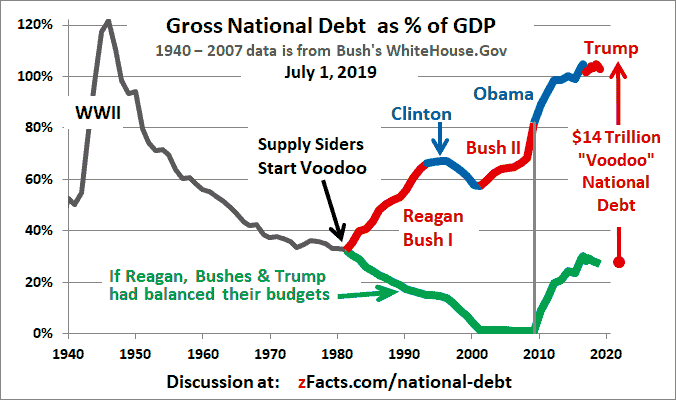
The chart at the right is the one that should be shoved in the face of any bullshitting wingnut who dares to suggest that Republicans are the party of fiscal responsibility. And note that anyone capable of putting chart A and chart B together will realize that the debt spike under Obama is really legacy spending from that codpiece wearing hero of the Mission Accomplished wingnuts, GW Bush, from his wars (the Iraq war will eventually cost over $6 trillion), his tax cuts (which we were told would create millions of jobs and resulted in the worst job creation record on record), TARP (started by Bush and finished by Obama, but only necessary because of Bush), recovery measures from the Little Bush Depression (like the stimulus, which was one-third tax cuts, something Republicans refuse to believe), and the reduced revenues due to the Little Bush Depression.

One last fact to keep in mind on this last graph: When calculating debt as a percent of GDP, it's important to remember that GW Bush's final GDP, in 4Q2008, was negative 9%. When GDP spikes down like that, and emergency spending goes up (job losses were at 800,000 per month when Obama took office and  in the three months before the stimulus passed, the economy cut loose 2.2m workers), the debt as a percent of GDP will, of course, go up. To blame that on Obama is the ultimate in bullshit.

"Private fixed investment as a percentage of potential GDP.
When it gets back to historical norms, the free lunch
on infrastructure investment will be over."
Neil Irwin, Washington Post
What this whole argument misses is that cutting the deficit right now is the worst thing to do. We should be be doing what the Congressional Progressive Caucus's People's Budget would do: borrow more at currently low interest rates, buy cheap materials, and put unemployed people back to work fixing our crumbling infrastructure, which would more than pay for itself. This won't happen, of course, as long as the GOP controls the House. But if they keep spewing their bullshit, and enough people learn the truth, maybe we can extend the half life of their polling plunge, take advantage of the hidden weakness of gerrymandering, and then keep the bullshitters talking long enough to replace them with some people who want to put this country back to work.

Wednesday, October 02, 2013

A Grain of Salt to Go with a Post from a Blogger I Admire

Ratio of government spending to potential GDP, via K-Thug
John Robb's a good guy. USAF Special Forces pilot, war expert, organic gardener... Writes a great blog on asymmetrical warfare called Global Guerrillas. Also writes a terrific blog on how to make yourself more resilient, Resilient Communities. I love that blog because, for environmental reasons, being resilient is a great idea. Also saves you money.

But his big reason for being resilient is that he thinks the nation state is hollowing and out, and he apparently doesn't believe that democracy can work out the huge problems we face. While I sometimes think he might be right, simply because Republicans seem determined to ruin everything if they can't get their way, I really wish he'd get his facts straight. Repeating right wing BS talking points to convince his readers that the government is going to fail might convince some of his right wing readers to plant a garden or install some solar panels, worthwhile goals indeed, but the lack of substance to his claims tends to just make him sound like another crackpot prepper (complete with the BS on the LifeLine, or Obamaphone, program!).

And since he's apparently decided not to post my comments correcting his mistakes, and I really believe he deserves this free service, I'll do it here...

"a government shutdown is nothing new. This is the 18th shutdown in the last 37 years."

Not really. As K-Drum points out today in his series of reminders you should read on this subject:
Prior to 1980, everything kept on running pretty normally during budget impasses. True shutdowns didn't happen until after a series of Justice Department rulings at the tail end of the Carter administration. Since then, there have been a handful of shutdowns prompted by garden variety disagreements over funding levels for defense and domestic programs, but they've been so brief as to be barely noticeable. The only exception was the long shutdown of 1995, prompted by Newt Gingrich's demands. 
So when you hear someone saying that there have been loads of government shutdowns in the past and this one is really nothing new, it just isn't true. In practice, there's only been one serious shutdown in recent history, and like this one, it was the product of Republican ultimatums.
"100% at the mercy of the 535 folks sitting in Washington posturing their next political move."

Jack Sheldon was the Bill who became a Law.
Actually, we're at the mercy of about 30 - 60 Tea Party Republicans in the House of Representatives who apparently never saw the Jack Sheldon School House Rock where he explains how a bill becomes law. You know, Democracy! What you flew jets to protect! That you blame both sides without understanding the dynamic that is causing this doesn't really help your case.

"This time, it’s not because of your safety, but just so the egos in Washington can watch out for your best interest."

What does this even mean? The egos in Washington that are causing this are a handful of Republicans that the Speaker of the House is too chicken to stand up to. All the Democrats in the House of Representatives would/will vote for a clean CR to keep the government going. And how was the last shutdown about safety? I thought it was about Newt Gingrich throwing a temper tantrum...

"The federal government stands for FAILURE."

Tell that to the millions of seniors and disabled people who aren't starving or freezing to death thanks to Social Security, SNAP, etc. It's still a shining city on a hill to those folks...

"Aside from its spending of over 9% of the total economy, the federal government is also deep in bed in key sectors, including; agriculture via Farm Bills, food and drugs via FDA and Food Stamps, banking and finance via the 6 agencies for oversight, rental real estate via Section 8 housing, cell phones via the LifeLine program and almost a dozen major undeclared wars since World War II."

Do you have a source for your numbers? Federal spending as a percent of GDP isn't really that far outside recent historic norms, considering the fact that we just had the biggest recession since the great depression (aka, The Little Bush Depression), and spending is designed to go up during bad times. In fact, federal spending as a percent of potential GDP is actually dropping now.

Feeding America
But I'm more interested in the details. While I agree that subsidies to highly profitable corporations are not helpful and a form of market rigging by the elites who like to redistribute wealth and income upward, you are lumping a lot of things together here that are actually quite different, and some of which are quite necessary if we'd like to live in a civil society where grandma doesn't have to eat cat food and keep her house 40 degrees in the winter. Cause, you know, Grandma can't exactly build an attached greenhouse or some solar panels. For instance, "76% of SNAP households included a child, an elderly person, or a disabled person." It's a very efficient program with very little waste that does a lot of good.

The FDA may be in the pockets of big pharma, (the bigger problem with drugs is that overly extended patents on drugs rip us off for about $300 billion a year), but when run by Democrats, they tend to take public safety a little more seriously than when run by Republicans who are just tools for the elites. Same with banking oversight. Republicans put foxes in charge of hen houses, and let Wall Street run wild enough to create the Little Bush Depression, while your Sr. Senator for Massachusetts is out there fighting everyday to make them more accountable. Doesn't seem fair to lump her in with the market riggers who caused the meltdown.

The "Obamaphone" program you mentioned is a favorite of wingnuts, which makes me wonder exactly where you're getting your information... The FCC recently enacted measures to save $2 billion over three years. In 2011, the program cost $1.6 billion (CEPR's handy budget calculator tells me this was 0.0452% of total spending in 2011--the horror!). And just today we found out that the strapping young bucks ripping off this government program include the wireless service providers. Odd that we don't blame these businesses for our future collapse as much as we do the "government."

And while you're well aware that I'm all for resilience, especially for environmental reasons, this kind of disingenuousness isn't helping:

"It would be easy to name billions, or trillions, of dollars of fraud and waste that goes into each and every one of these agencies and programs. Including the trillions of dollars of promises made into the future that they can’t mathematically keep (it may even be hard for them to print money fast enough to meet the demand)."

Actually, the amount of fraud and waste in our social insurance and welfare programs is surprisingly low. Social Security, Medicare, SNAP, AFDC, Section 8, all run very efficiently, and have very low rates of fraud. The idea that they are riddled with fraud is generally perpetuated by bullshitting conservatives and libertarians who care more about making a certain impression than they do about facts.

Further, our "unfunded" mandates are also overblown by the right wing blowhards. Social Security is fine for decades, at which point the relatively small shortfall could easily be made up for by lifting the cap on earnings subject to the tax, lowering payments, or increasing the tax slightly.

Via the Washington Post
The rapid rise of health care costs have slowed down, at least partially because of Obamacare. Maybe this is why the market rigging GOP is trying to stop it? Because it will fight the rapid cost increases in health care sector that are THE single issue driving our long term debt, but which also put money in the pockets of their contributors? We pay twice as much per person for health care that the rest of the civilized world. If we paid even close to what they pay, we'd have surpluses as far as we could see, even at current low historical tax revenues and high defense spending.

So, yeah. I love your work, man, but when you venture off into this stuff, it's like you're just regurgitating the BS scare tactics from Fox News. Read some Dean Baker and find out the actual facts about these things. You'll be doing your readers an even bigger favor if you use facts to make your case, instead of the right-wing detritus you're scooping up off the side of the road.

Saturday, August 03, 2013

David Brooks Channels Mike Rowe While Dean Baker Takes the Dirty Job of Cleaning Up Their Pile of Crap

David Brooks goes all Mike Rowe with the BS about skills shortages in the US labor market:
It [weak job growth] probably has to do with a skills shortage, that as technology increases, skills have got to keep up and skills are just not keeping up...
It's a dirty job, but Dean Baker slaps Brooks upside the head with some basic economic facts:
If this claim were true it would mean that there are substantial segments of the labor market where we are seeing labor shortages. That would mean that workers in some occupations would be seeing rapidly rising wages. We should also see industries or occupations where the length of the average workweek is increasing rapidly. Employers would be trying to get the workers they have to put in more hours, since they can't find additional workers. In these industries/occupations we should also see a high ratio of job openings to unemployed workers. There are no major areas of the labor market where we see this evidence of labor shortages. In other words, Brooks is just making this up out of thin air.
Mike Rowe said he'd probably vote for Romney. This tells me that the Ford spokesman is likely a corporate shill. So it shouldn't be surprising to find out that his supposed "skills gap" is really a bunch of corporate bitching that they can't find people to do these jobs because they won't raise pay enough to actually attract the qualified applicants.

On Real Time, Rowe gave the example of a Caterpillar heavy equipment company in Las Vegas (probably Cashman, which doesn't post wages on it's job listings). He claims those jobs start at 40K a year, for operating heavy machinery. He says in a few short years you can make $120,000 a year. He's full of shit.
The U.S. Bureau of Labor Statistics reports the median wage for heavy equipment operators in the United States is $41,870, an hourly wage of $20.13 per hour, as of May 2012. The average nationwide for those who operate bulldozers, backhoes, cranes and road grading machinery is slightly higher than the median, at $46,270 per year, or $22.24 per hour.
So, here's the problem. He's spewing the right wing "skills gap" BS because this is how Republicans blame "lazy" and "uneducated" kids who don't want the dirty jobs, instead of the large corporations that refuse to follow the laws of supply and demand when it comes to labor.

Private fixed investment as a percentage of potential GDP. Via Wonkblog
And these people claim to be capitalists who believe in free markets... Free markets mean supply and demand rules apply. If you need more of a supply of skilled labor, and you're not getting them, then you need to pay more for it. Since, as Mr. Baker showed, there is no rise in wages for these kinds of jobs, and there is no increase in hours worked by those already employed in these jobs, then there is no shortage.

It's an elaborate Bullshit Mountain ( Jon Stewart) constructed by our market-rigging financial elites designed to distract us from the real problems, which are lack of demand due to the housing bubble and Little Bush Depression, and lack of investment in infrastructure which would more than pay for itself by making us safer, more productive, and more competitive.

Borrowing costs are very low right now. Labor costs are low. Materials costs are low. Equipment is sitting idle. The markets are screaming at us to invest in infrastructure. What part of "buy low" don't these supposed capitalists get?


Tuesday, July 23, 2013

Nate Silver Should Start the New Intrade

So many great buying opportunities.
Kevin Drum is skeptical that Nate Silver has anything to add on weather and economics.
But weather, economics, and education? I'm skeptical that you can just parachute into those fields and add a lot of value. They're far more complex, are already heavily populated with sophisticated statistical modeling, and generally require some serious subject matter expertise in addition to raw number-crunching skill.
I don't know what he wants to do on education, but weather and econ sound interesting. It sounds a lot like the Intrade markets I did so well in: climate, politics, and economics. What I want to see is Nate and some rich friends of his create a new Intrade, by taking advantage of the new state laws in NV and NJ for online gambling, which the DoJ said they weren't going to challenge.
This week, New Jersey became the third state, after Delaware and Nevada, to pass an online gambling bill. This came thanks to a complete reversal in policy at the U.S. Department of Justice. For years the agency had said online gambling was illegal—a violation of the Wire Act of 1961 that bans betting across state lines—and had prosecuted the owners of online gaming sites. Then late last year it told states wanting to start online lotteries that the Wire Act applied only to sports betting and not to other games. Industry observers were shocked. “The Justice Department came out 180 degrees opposite of where it was before,” says David Stewart, a lawyer specializing in gambling law at Ropes & Gray. “I’ve never seen that.”
So, I guess I should thank Eric Holder for the eventual return of my denier's tax revenues.

Thursday, March 28, 2013

The Eternal Sunshine of the Glibertarian Mind: an Open Letter to Freshwater Economists


Much of US political history was a kind of de facto libertarianism. Modern libertarians often deny it, and rightly point out that it was not "true" libertarianism (what political system is ever perfectly applied?) but it was very libertarian. It kind of had to be. It was a big country. Travel took a long time. It was impossible to enforce strong federal laws, so they tended to be weak. It led to robber barons, monopolies, weak regulations, corruption, and lack of adequate oversight by people who didn't want to spit in the soup they would be drinking out of.

Sound familiar?

What we know about these past days of no workplace safety rules, no overtime, no minimum wage, no OSHA, no anti-trust, and no child-labor laws is that those days sucked. The vast majority of humans suffered mightily, despite the fact that they worked hard, found ways to increase their own productivity, and in many cases took years off their lives for the enrichment of their bosses. For their trouble they were treated like shit. There was no market punishment for treating workers poorly, only rewards. They stole people's labor and productivity, and no one could do anything to stop them.

Sound familiar?

Government is how we protect ourselves from corporations run wild--cost-shifting negative externalities onto tax payers, polluting and rigging the markets, and daring me to sue in a court they bought. Gutting, laws (using politicians they bought), or passing laughingly weak ones, is now the logical extension of the power of money being called equal to speech, and corporations being called persons. I want no part of that. My ancestors fought in the coal wars, and I'll be damned if I'm going to sit by while I listen to someone who would glibly take us back to the days when people would get so pissed they'd take up arms and literally wage war to stand up for their rights and what they believed in.

"Left wing" market riggers, too,
here behind Mr. Ayn Greenspan
Sound familiar?

You can put a water fountain in the middle of your Freshwater Economics pond and flash pretty lights on it all day, but the greatest quote about this subject is Alan "Ayn Rand Loved Her Some Medicare and Social Security" Greenspan, who famously said:
"Today’s competitive markets, whether we seek to recognise it or not, are driven by an international version of Adam Smith’s “invisible hand” that is unredeemably opaque. With notably rare exceptions (2008, for example), the global “invisible hand” has created relatively stable exchange rates, interest rates, prices, and wage rates."
Things are better than they were back in the day of the Battle of Blair Mountain. This is largely because our well-regulated markets have been more efficient than those of the past. I fully support efforts to make our markets more fair and free for everyone. Just check out Dean Baker's free Ebook The End of Loser Liberalism for some examples of the kind of thinking I admire.

Knowing all this history, basic economics, and simple logic, you'd have to be gargantuanly Glib to even say out loud that the markets would behave better if we let them be more free. We just had yet another giant supply-side experiment. It's what they've been conducting on us lab rats since Ronny and the Tricke-down-o-nauts set the charts ablaze some 33 years ago with their number one hit We'll Be Taking Your Productivity Now.

Washington Post
And once again, it has led to income inequality way more severe than Americans think it is, much less where they think it should be. Once again it has led to bubbles, booms and busts, persistently high unemployment, and a lack of investment in public infrastructure that is literally costing us hundreds of billions of dollars and tens of thousands lives every year.

I wonder what Libertarians would do if terrorists were killing as many Americans every year as our deteriorating infrastructure is?

The latest "notably rare exception," the Little Bush Depression, was worse than the last four recessions combined. The loss of public sector workers is unprecedented in a modern recovery, making the misery even worse. A great many people lost their homes, their health, their lives, their cars, their children, all through no fault of their own. All because the right leaning policies put in place since Reagan--unfettered markets coupled with open incentives toward certain favored industries--have done nothing but rig the markets to help redistribute income and wealth upward.

You Freshwater "economists" can put together extremely well debunked, life-destroying policies and call them custard pie all you want, but you're really just deluding yourself. It's a good thing you don't care about the politics of your politics, because you'd be sorely disappointed at your prospects. And it's not because we're all a bunch of dumb ass statists sucking off the giant teat. It's because progressives want to protect a free and fair market economy by setting the ground rules that let management and labor get down to business* instead of bitching and ripping each other off every chance they get.

*If that sounds familiar, see Costco v Walmart, for example.

Tuesday, March 19, 2013

Smoking Guns: The New Infrastructure Report Card

Fork in the Road Info Graphic from the ASCE's Infrastructure Report Card
(Click for high-res version)
"You know a D turns into a B so easily."--Homer Simpson
Every four years, the American Society of Civil Engineers releases an infrastructure report card. If America had a Mom and Dad, they wouldn't be too happy right now.The grades are out, and the bottom line is a D+. The estimated investment needed by 2020 is $3.6 trillion.

Considering that the Iraq war cost will, after interest on the debt and Veteran's health care, come to $6.2 trillion, I'd say our grandchildren were doubly robbed. If some wingnut had the balls to say, well, we blew our infrastructure money on Iraq, so we'll just have to suffer, I would calmly suggest that what he knows about economics, if converted to gasoline, wouldn't fill a piss ant's go-cart enough to go around a cheerio once.

I'm not Dean Baker, but as he likes to point out, I have an advantage over many so called economists in the pundit class--I can do basic arithmetic. 2020 is 7 years away. $3.6 trillion, divided by 7 equals $514,285,714,285. A half a trillion dollars a year for 7 years to get our infrastructure up to par would, of course, be a major investment. It would require borrowing a lot more (at negative real interest rates). It would require hiring a lot of unemployed people. It would require buying a lot of materials that are currently cheap. We would have to, essentially, be willing to buy low. The payoffs for this investment are enormous (see the info-graphic, right).

This is from the executive summary of the report card:
We know that investing in infrastructure is essential to support healthy, vibrant communities. Infrastructure is also critical for long-term economic growth, increasing GDP, employment, household income, and exports. The reverse is also true – without prioritizing our nation’s infrastructure needs, deteriorating conditions can become a drag on the economy.
One would think that the very real threat we face from our crumbling infrastructure would be enough to make Americans want to spend to save all the people that will die on our crumbling roads, our collapsing bridges, or from our exploding gas mains... If only we could make infrastructure spending as sexy as shock and awe...

The report card from 2009 stated that 1/3 of all traffic fatalities, or about 10,000 deaths per year, are caused by poor road conditions. I wonder how much money we'd spend on war if terrorists were killing that many Americans every year?

The report card is full of all kinds of interesting facts that won't make it to the news, where mythical mushroom cloud smoking guns get more air time. The report card is full of many warnings of what will happen if we don't invest, none of which will get the kind of main stream air time as Dick Cheney telling us we'd be greeted as liberators, or Donald Rumsfeld telling us the WMD are "...in the area around Tikrit and Baghdad and east, west, south, and north somewhat." In short, this report card, like the last one, will get ignored, for the most part, by the press that helped sell us a $6 trillion war.

Since so many in the American Press were so anxious to get us into that war, we aren't hearing a whole lot about the group-think of calling anyone who doubted Bush and Cheney a traitor. We won't hear much from a press (that bought the lies) about those lies. But here we have a chance for all the reporters and pundits, from Bill "Iraq has been won decisively and honorably" Kristol to Tom "FU" Friedman, to step up and recommend we spend big on something that will cost a little more than half of what Iraq cost, and this time the spending really will more than pay for itself.

So what are you waiting for? All you Iraq War cheerleaders should be out there now, with this report card (they even have an app) in your hand, telling the intransigent House GOP to get off their bloody hands and fix this country now. After all, we wouldn't want the smoking gun to be another city block going up in a gas main explosion.


Monday, February 11, 2013

Step Right Up and Get Your Shiny New Infrastructure

Steel Mill in Bethlehem, PA, photo by S Supak

What part of buy low don't you "conservatives" get? Invest now, while it's cheap! Borrow at real negative interest, and you pay less than tax and spend later. Hire unemployed workers now and you don't crowd out private construction later. Stimulate growth now, increased revenues lower deficits later. Duh.

It comes as we may be approaching the end of a five year period in which investing in the nation’s physical infrastructure has been something close to a free lunch. With interest rates near all-time lows and millions of construction workers unemployed, the last few years have been a time that it would have been a historical bargain for the United States to do upgrades to roads, bridges, and airports that will eventually need to take place anyway. It has been a political breakdown—in particular conservatives’ view of almost any non-defense federal spending as wasteful—standing in the way.

The American Society of Civil Engineers says we need to spend $2.2 trillion over 5 years to fix what's falling apart. Whole city blocks have exploded from leaking gas mains. Bridges have collapsed and killed people. One third of all traffic fatalities involve poor road conditions. If terrorists were killing as many people as our decrepit infrastructure is, how Keynesian would you "conservatives" get on defense spending?

And just look what we can fix with the money (from the ASCE):

Americans spend 4.2 billion hours a year stuck in traffic at a cost of $78.2 billion a year--$710 per motorist. Roadway conditions are a significant factor in about one-third of traffic fatalities. Poor road conditions cost U.S. motorists $67 billion a year in repairs and operating costs--$333 per motorist; 33% of America's major roads are in poor or mediocre condition and 36% of the nation's major urban highways are congested. The current spending level of $70.3 billion for highway capital improvements is well below the estimated $186 billion needed annually to substantially improve the nation's highways.

Neil Irwin goes on in his post to Ezra Klein's blog to mention the politics of it. Seems Republicans are concerned we'll just use their money to build bridges to nowhere. Interestingly, the President's JOBS bill, up on Capital Hill, has funding to start an infrastructure bank, a bi-partisan idea that eliminates a lot of the politics from infrastructure investment, to avoid just such a thing. But maybe the "conservatives" have forgotten that they once liked that idea?

Saturday, July 25, 2009

What do I think of that?

That being an interesting email to a friend, forwarded to me, that used the health care debate to demonstrate--surprise, surprise--that corporate America will once again get it's way, to everyone's detriment. My forwarding friend asked me what I think...

Hmmm... Well, let's see. I'm so fucking broke that I'm down to my last cherished possessions to sell to make the rent. I'm sitting here slowly panicking, with no TV, cell phones long gone, basic phone about to go, two months behind on my car, one behind on my daughter's car, in default on about 30,000 worth of credit card debt, a landlord that will kick us out in 30 days if we're late on the rent, 500 a month in food stamps that barely covers our food every month, and I've got government health care because my income is less than 12,500 per year--meaning we're officially poor.

I'd get a job, if there were any for someone who can't lift over 20 lbs. I have found some burger flipping jobs so far away that half my day working would barely cover the gas to get there.

So what do I think of some health care bullshit that would take me hours to find out if it's true, which it probably isn't because everyone's got their fucking agenda, while most of the people in this fucking country have lost their retirement, are barely getting by, and, according to the latest gun and ammo sales records, heavily armed?

What do I think?

I think whoever wrote it is onto something. But it's old news. I have two blogs you should subscribe to. I suggest you send them to your friend who wrote this.

Club Orlov. Note, especially, this post on American Swine from Kollapsnik.

And Global Guirillas, by John Robb, who recently testified before congress. He's a military expert who analyzes everything with a very clear POV.

I voted for Dennis Kucinich too, but we smart people don't run this country. The rich people do. Sometimes they're smart, but most of the time they're stupid greedy dumbasses with the power to make us feel a whole lot of pain. Their bad decisions have WAY more ramifications than ours ever will. Resilient communities, as Robb calls them, will be the new society: localized, sustainable, and resilient. Globalization will not stand.

And, all you philosophers out there will note that it wasn't Nostradamus who predicted this (voodoo bullshit, that). It was Karl Marx. Maybe if corporate America hadn't been getting rich demonizing him for the last, oh, few decades, we'd have learned something from him: That unregulated greed will be the death of capitalism, at least on the large scale. I'd say we're headed back to mercantilism.


There.

Sunday, February 15, 2009

Look on the Bright Side

It's rare that I read something that drops my jaw, but check this out, from Dmitry Orlov's speech at the Long Now Foundation (h/t to John Robb of Global Guerillas):

Forget “growth,” forget “jobs,” forget “financial stability.” What should their [the government's] realistic new objectives be? Well, here they are: food, shelter, transportation, and security. Their task is to find a way to provide all of these necessities on an emergency basis, in absence of a functioning economy, with commerce at a standstill, with little or no access to imports, and to make them available to a population that is largely penniless. If successful, society will remain largely intact, and will be able to begin a slow and painful process of cultural transition, and eventually develop a new economy, a gradually de-industrializing economy, at a much lower level of resource expenditure, characterized by a quite a lot of austerity and even poverty, but in conditions that are safe, decent, and dignified. If unsuccessful, society will be gradually destroyed in a series of convulsions that will leave a defunct nation composed of many wretched little fiefdoms. Given its largely depleted resource base, a dysfunctional, collapsing infrastructure, and its history of unresolved social conflicts, the territory of the Former United States will undergo a process of steady degeneration punctuated by natural and man-made cataclysms.

Monday, January 05, 2009

A Crock Full of Happiness

Happiness is always a by-product. It is probably a matter of temperament, and for anything I know it may be glandular. But it is not something that can be demanded from life, and if you are not happy you had better stop worrying about it and see what treasures you can pluck from your own brand of unhappiness.—Robertson Davies
What a crock. Here's a man who's father was a Canadian Senator. He never went hungry or cold. His family owned a media empire. Was there anything he ever had to worry about? Did he have unhappiness to pluck treasures from, or did his treasures just show up via the family bank account?

Is happiness always a by-product? Of what? When I play guitar I'm happy. Is the happiness a by-product of my playing guitar, or is it the reason I play? I certainly don't play guitar to be sad. In a very important way, the happiness is what I am seeking when I play guitar. It is no more a by-product than the music, the vibrations, or the art. The happiness is integral. Even when I play a sad song, that reminds me of someone who's dead, or ill, I still feel better during and after playing the song.

Is happiness a matter of temperament?
3 a: the peculiar or distinguishing mental or physical character determined by the relative proportions of the humors according to medieval physiology b: characteristic or habitual inclination or mode of emotional response c: extremely high sensibility ; especially : excessive sensitiveness or irritability
This last definition helps to prove the opposite, that is, that unhappiness can be a matter excessive sensitiveness or irritability. But Davies is suggesting that happiness is a matter of inclination or mode of emotional response. Well, duh. If you're inclined to be happy, you will be. If you're unable to pay your rent because your illness has made it impossible to be gainfully employed, while your government has lowered the safety net to within inches of the floor it's supposed to stop you from hitting, well, then you're not exactly inclined to be happy.

If you worked 20 years to find that the work you've been doing has been destroying your body to the point where you can't do the work anymore, that's an inclination toward a mode of emotional response that Davies was likely unfamiliar with: fear and loathing.

Can happiness be demanded of life? Sure. Here: I demand happiness. Did that help me get any? Did my life listen to me? Did anyone? Doesn't the act of demanding something make me sound like a spoiled kid who expects his parents to provide whatever he needs and desires?

How about if I'm just provided with what I need? Would that be enough to make me happy? Well, show me the happy starving people. Show me the happy homeless people. I knew a homeless guy who was a pretty good harmonica player. He was a Vietnam veteran who begged by the freeway exit in downtown Los Angeles. I would drive by on my way to get paid for destroying my spinal cartilage. I would talk to him on my lunch break sometimes. Always gave him a few bucks, and he would play a little blues. Sounded good. He looked happy while he was playing. And then he would stop, put the harmonica back in his pocket, and look miserable again. Think maybe a room, three square, and some new shoes would make him happier? You bet it would. Are those bare necessities something he can demand? Sure. Will that demand get him those things? Not if no one who can help is listening.

What about happiness being glandular? Or, since Mr. Davies lived before modern brain chemistry science, we'll be magnanimous and say maybe happiness can be given medically. Is there a happy pill? Can some drug make me forget that I can't pay my electric bill? Can some medical treatment make me happy that I can't send my kid to college, or that my car's going to be repossessed?

As part of my pain management regimen of daily drugs, I was on Prozac (fluoxetine hydrochloride) for a while. Technically, it's more of an anti-unhappy pill, and for pain patients it's usually given in small doses. It's a selective serotonin reuptake inhibitor, which means, if the theories are correct, depression can be avoided because the drug helps serotonin stay in the synaptic gap longer than usual, helping the receptors of the recipient cell by stimulating it. New research suggests that a persons genetic make-up may make them unable to benefit from these drugs, so, in their case, there isn't much hope for unhappiness being treated glandularly, it seems happiness is not glandular. At least not yet. The prospect of designer drugs may yet create your own personal soma, but religiously inspired restrictions in stem cell research have put that on the back burner for a while.

For other people, like me, for whom the side-effects (diarrhea, nausea, inability to ejaculate) of the happy pill only cause further unhappiness, it doesn't make much sense to take the pill. The small amount of pain relief caused by reducing the amount of depression is offset by the depression caused by the side effects. The glandular route to happiness, or less unhappiness, if it exists at all, isn't available in this case either.

For some people, Prozac, and other anti-depressants, works. It makes their lives a little more bearable. But in those cases, it seems, the drug is being used to correct a chemical imbalance in the patient's brain. Have we made them happier? In the sense that we have reduced their unhappiness, yes. But, this is only for some people. So, as a universal definition of happiness, it seems to not be glandular.

Since the unhappiness being experienced by the desperate, the poor, the sick, et al, is something we've evolved to feel, an uncomfortableness that supposedly motivates us to pluck some improved existence out of fat air, maybe we shouldn't be messing around with it. Perhaps the run of the mill unhappiness, created by forces outside of our control which we are supposed to deal with in some magic way (which the Republican Party defines as entrepreneurial free market forces coupled with hard work), should be allowed to run the mill, so to speak. Perhaps unhappiness, and the stress that works in conjunction with it, creates the impetus to do something to improve things, to end the unhappiness, to create happiness.

So, I'll write something. I'll play the guitar. I'll feel better for a while. And then I'll hear the rush of air, feel the weightlessness of free fall, and reality will rush back in like the flight or flight response. I'll send more letters to relatives begging for a loan, or work, or charity. I'll contact more former clients asking them if they need work done. I'll plow through more emails from more people telling me how hard this recession is hitting them too. And I'll be right back where I was, falling through the financial air with the greatest of ease, wondering if the "safety net" that's left after 8 years of Bush's Disaster Capitalism will stop my fall before I hit the ground. And then I will stop worrying for a moment about my ruined credit, stack of medical bills, negative bank balance, and near empty propane tank covered in snow, to see what treasure I can pluck out of my brand of unhappiness.

What a nice view.

Friday, January 02, 2009

On Unhappiness

I've been lucky. I've never been really destitute, although there have been times, like now, where I've had to eat a lot of beans. My credit has gone from bad to good to back to bad again.

But what I'm facing right now is like no other time, ever. After my disability forced me to stop working as a stagehand, I had some money saved, cashed the 401k, and managed to move out of Los Angeles and up here to upstage upstate NY, where it's cheap and we have family. I was managing to pay the bills with the small income I got from my internet marketing business.

That's all changed now. The savings are all gone. The business is drying up as this economy forces my clients to cut back, and keeps new ones from stepping up. The credit is maxed out and ruined, the bills are stacking up, cut-off notices are coming in, and the only money on the horizon isn't until a possible settlement or court decision in my worker's comp case back in California.

So, when I hear people talk about how Americans are still pretty happy, or that money can't buy happiness, or that everything's going to be OK if you just believe it, I just want to say, bullshit.

And it's not just me. Americans in general just aren't feeling the love right now. In a post about the state of happiness in the US, Freakonomics blogger Justin Wolfers goes over the evidence that this is a very unhappy time in America.

We’re still happy? No way. Life satisfaction has plummeted during the recession.


And all that crap about money not buying happiness, or money not making people any happier past a certain cut-off point. Also bullshit. Besides the obvious, I mean, sure, there are unhappy billionaires, but show me happy starving people... If you really look into the economic data, it seems that the richer you are, the happier you are.

Is that really a surprise?

I'm more interested in the down side. How unhappy do you get as they money dries up? How unhappy are the hungry and the homeless compared to those who are still, albeit just barely, getting by? How low can you go before your heart breaks, your will caves in, and you just give up?

This all is, of course, quite subjective, but we do have sociological studies into this. In these trying times, perhaps it would be a good idea to really study unhappiness, it's effects on people's health and behavior (crime rates are going up), and find ways that we can help people who are, like I am, at their wit's end.